

Self-Study Library Business: Costs, Profit and Break-Even
Key takeaways
- Earnings depend on occupancy more than price: an empty seat-shift earns nothing but still costs rent and electricity.
- Break-even seat-shifts = monthly running costs ÷ average fee per seat-shift.
- Rent and electricity are usually the largest running costs. AC raises both your fee and your power bill.
- Unpaid fees, seats held by students who have left, and a half-empty shift quietly reduce profit.
- Use your own quotes and local fees. The numbers in this guide are an example, not a benchmark.
A self-study library has a simple model: you pay for space, furniture and running costs, and students pay a monthly fee for a seat in a shift. Whether it makes money comes down to three numbers: your monthly costs, your average fee, and how many seat-shifts are actually filled.
All numbers below are an illustrative example for a 50-seat library in a mid-sized city. Rent, electricity tariffs, furniture prices and fees vary widely, so replace every figure with quotes and prices from your own area.
One-time setup costs
These are spent before the first student joins.
| Item | What it covers | Example (50 seats) |
|---|---|---|
| Desks and partitions | Cabin-style desks for each seat | ₹1,50,000–₹2,50,000 |
| Chairs | Chairs comfortable for long hours | ₹75,000–₹1,25,000 |
| Lighting and wiring | Desk lights, charging points, wiring | ₹50,000–₹1,00,000 |
| AC or fans | Split ACs, or fans and exhaust | ₹1,00,000–₹2,50,000 |
| Power backup | Inverter and batteries, or a generator | ₹40,000–₹1,00,000 |
| Other | CCTV, Wi-Fi router, RO, lockers, signboard | ₹50,000–₹1,00,000 |
| Rent deposit | Security deposit to the landlord | Often several months' rent |
In this example, setup comes to roughly ₹4.5 lakh to ₹9.5 lakh plus the rent deposit. A non-AC library with simpler furniture costs much less. A premium AC library with full cabins costs more.
Monthly running costs
| Cost | Example per month |
|---|---|
| Rent | ₹30,000 |
| Electricity | ₹10,000 |
| Staff (part-time receptionist) | ₹8,000 |
| Cleaning | ₹4,000 |
| Internet, water, repairs, small items | ₹3,000 |
| Software and marketing | ₹1,000 |
| Total | ₹56,000 |
If you run AC, electricity can swing a lot between summer and winter. Plan for the expensive months, not the average.
How much a library earns
Capacity is seats × shifts. With 50 seats and two shifts (morning and evening), you have 100 seat-shifts to sell each month. A full-day member takes one seat in both shifts, so counts as two.
Say your fee is ₹800 per shift per month (₹1,600 for full day).
- At 100% occupancy: 100 × ₹800 = ₹80,000 a month.
- At 80%: ₹64,000.
- At 60%: ₹48,000.
Against ₹56,000 of running costs, this library loses money at 60% occupancy, earns ₹8,000 at 80%, and earns ₹24,000 only when completely full.
The break-even formula
Break-even seat-shifts = monthly running costs ÷ average fee per seat-shift.
In the example: ₹56,000 ÷ ₹800 = 70 seat-shifts, which is 70% occupancy. Every filled seat-shift above 70 is profit before tax.
To estimate how long setup takes to pay back, divide the setup amount by your expected monthly profit. ₹7 lakh of setup at ₹16,000 profit a month (90% occupancy in the example) takes about 44 months. That is why owners work hard on filling the weaker shift and keeping members longer.
Ways to improve profit
- Fill the weaker shift. One shift is often fuller than the other. A lower price for the weaker shift can still add profit, because the rent is already paid.
- Sell longer plans. A discount for 3 or 6 months paid in advance improves cash flow and keeps students longer.
- Collect every fee on time. Pending fees are money you have earned but not received. Follow up on the day a fee is due.
- Free seats quickly. When a student stops coming and does not renew, release the seat so the next student on the waitlist can take it.
- Track expenses. Write down every electricity bill, repair and salary, so you see real profit each month instead of a guess.
- Add small services carefully. Lockers, printing or a tea corner can add income without needing more space. See Side Businesses for a Study Library.
Common mistakes
- Buying furniture before drawing the layout and counting seats.
- Pricing below nearby libraries without checking that the numbers still cover costs.
- Forgetting the summer electricity bill when planning AC.
- Keeping fees in one notebook and expenses in another, so profit is never clear.
How Libolink helps
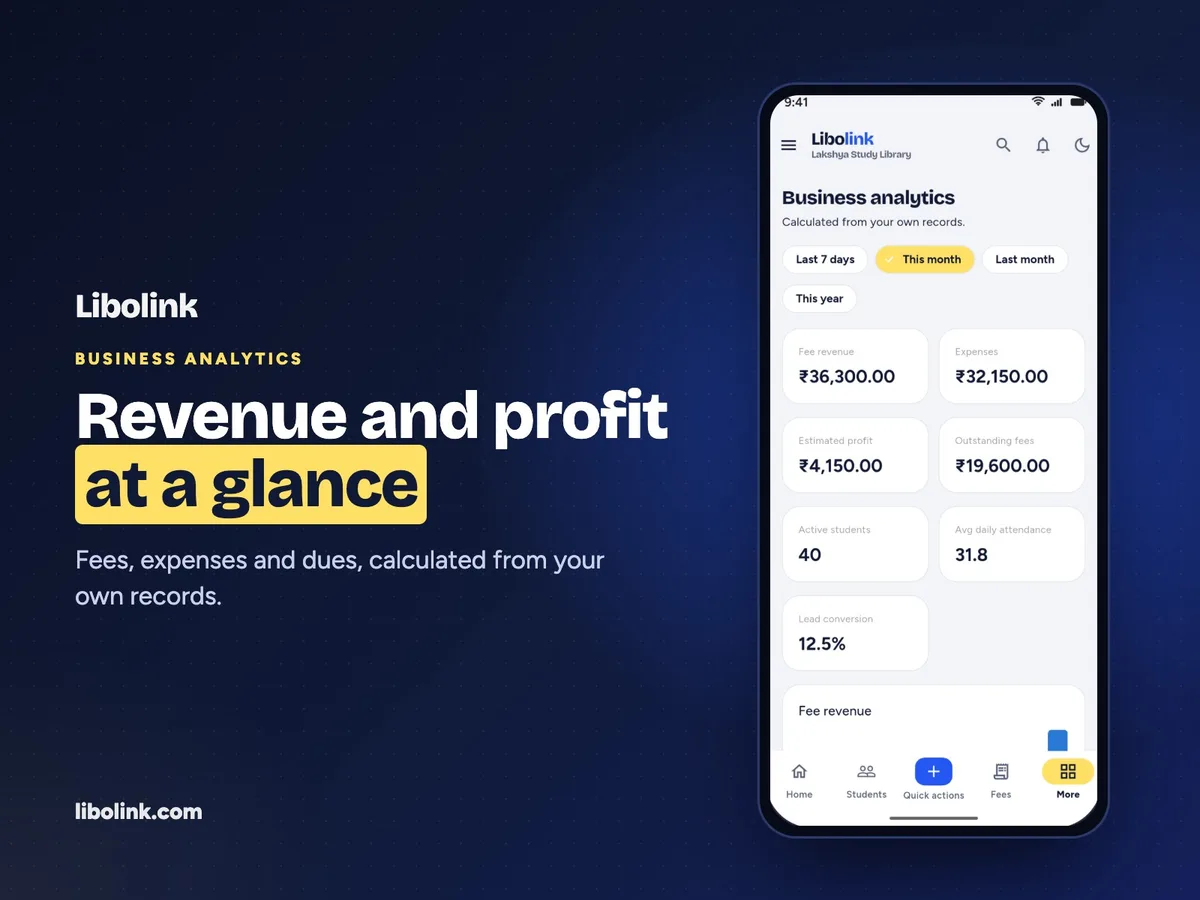
Libolink's business analytics shows fee revenue (after refunds), expenses, estimated profit and outstanding fees for any period, so the break-even maths uses your real numbers. The seat map shows which seats are empty in each shift, the waitlist helps fill them, and fee reminders help you collect on time. See pricing or start a free trial.
Frequently asked questions
Is a self-study library a profitable business?
It can be when occupancy is high. Profit depends on rent, electricity and how many seat-shifts are filled. Work out your break-even (monthly running costs divided by your average fee per seat-shift). If you can realistically fill well above that, the business can be profitable.
How much does it cost to open a self-study library?
It depends on the number of seats, AC, furniture quality and your city. A 50-seat library can range from a few lakh rupees for a simple non-AC setup to ₹10 lakh or more with AC and cabins, plus the rent deposit. Get local quotes before deciding.
What occupancy does a study library need to break even?
Divide monthly running costs by the average fee per seat-shift. With ₹56,000 of costs and ₹800 per seat-shift, a library needs 70 filled seat-shifts, which is 70% occupancy for 50 seats and two shifts.