

Side Businesses for a Study Library: Canteen, Discussion Room and More
Key takeaways
- The best add-ons serve students who are already in the building and do not disturb the quiet.
- A tea and snack corner, lockers and printing are the easiest to start.
- A bookable discussion room earns from group study without breaking the silence rule in the main hall.
- Selling food needs FSSAI registration, and extra income counts towards your GST turnover. Check with a CA.
- Keep noise, smells and crowds out of the study hall, or the add-on will cost you members.
A study library's main income is limited by seats × shifts. Once your seats are mostly full, the next way to grow is to earn more from the students who already come every day. The rule for any add-on: it must not disturb the quiet that students pay for.
Quick comparison
| Add-on | Setup effort | Space needed | Noise risk | Good for |
|---|---|---|---|---|
| Tea and snack corner | Low to medium | A corner or balcony | Medium | Almost every library |
| Vending machine | Low | Very little | Low | Libraries with long hours |
| Lockers | Low | One wall | None | Full-day and long-plan students |
| Printing and stationery | Low | One desk | Low | Notes, test papers and forms |
| Discussion room | Medium | A separate room | Contained | Group study and doubt sessions |
| Book and notes rental | Low | Shelves | None | Exam-focused libraries |
| Mock test sessions | Medium | The main hall at off hours | None during tests | Competitive exam students |
| Room for classes | Medium | A separate room | Contained | Libraries near coaching hubs |
| Daytime coworking seats | Low | Existing seats | Low | Mornings with empty seats |
Tea and snack corner
Students sit for hours, and many step out for tea. Keeping them in the building is convenient for them and earns for you.
- Keep it outside the hall: a balcony, the entrance area or a separate room, with a door between it and the study hall.
- Keep the menu simple: tea, coffee, biscuits, packaged snacks and water, perhaps one hot item. Avoid strong-smelling food.
- Licence: selling food needs FSSAI registration. Small businesses can usually start with basic registration, which covers annual food turnover up to ₹12 lakh.
- Less effort: rent the corner to a local tea seller for a fixed monthly amount, so you earn without running it.
Vending machines
A coffee or snack vending machine needs almost no staff. Many vendors install machines on rent or revenue share, so compare offers before buying one.
Lockers
Students preparing for long exams carry heavy books. Lockers let full-day and long-plan students leave them overnight.
- Charge a small monthly fee, or include a locker in a premium plan.
- Take a refundable key deposit, and record who has which locker.
- Keep a master key, and write down the rule for opening a locker that is not renewed.
Printing, stationery and form-filling help
Notes, test papers and exam application forms all need printing. A printer-copier and a small stationery shelf (pens, highlighters, registers, sticky notes) earn steadily and save students a trip. Many students also need help applying for exams online: filling forms, uploading photos and paying fees. With a computer and printer this can be a small paid service, as long as you handle students' personal details carefully. Keep the printer away from the hall, because printers are noisy.
A bookable discussion room
Silence in the main hall is non-negotiable, but students also need to discuss, revise together and clear doubts. A separate room solves both.
- Rent it by the hour to groups, or include a few hours a month in premium plans.
- Use it for weekend doubt sessions, group reviews of mock tests or talks by mentors.
- Make sure sound does not travel: a solid door with seals, and no gaps into the hall above or below the walls.
Book and notes rental
Exam books are expensive. A small collection of standard books and previous years' papers, rented by the month or included with membership, is valued by students and costs little to run. Keep a simple issue register.
Mock test sessions
Many competitive exams are computer-based or OMR-based. Running timed mock tests in your hall at off hours, such as Sunday mornings, alone or with a coaching partner, gives students exam practice and you a weekend income.
A room for classes
If you have a separate room, a coaching teacher or test-series provider may rent it for evening or weekend batches. Their students then walk past your library every week. Keep classes physically separate from the study hall.
Daytime coworking seats
If morning seats are often empty, offer them to remote workers or freelancers who need a quiet desk and Wi-Fi. The same silence rules apply, with calls taken outside.
What to check before adding anything
- Noise and smell: if it can be heard or smelled in the hall, move it or drop it.
- Space: do not remove seats for an add-on unless it clearly earns more than those seats. Self-Study Library Costs and Profit shows what a seat is worth.
- Licences and tax: food needs FSSAI registration, and extra income counts towards your GST turnover. Ask a CA.
- Staff time: an add-on that needs someone at a counter all day may cost more than it earns.
- Start small: try one add-on for a month, count what it earns, then decide.
How Libolink helps
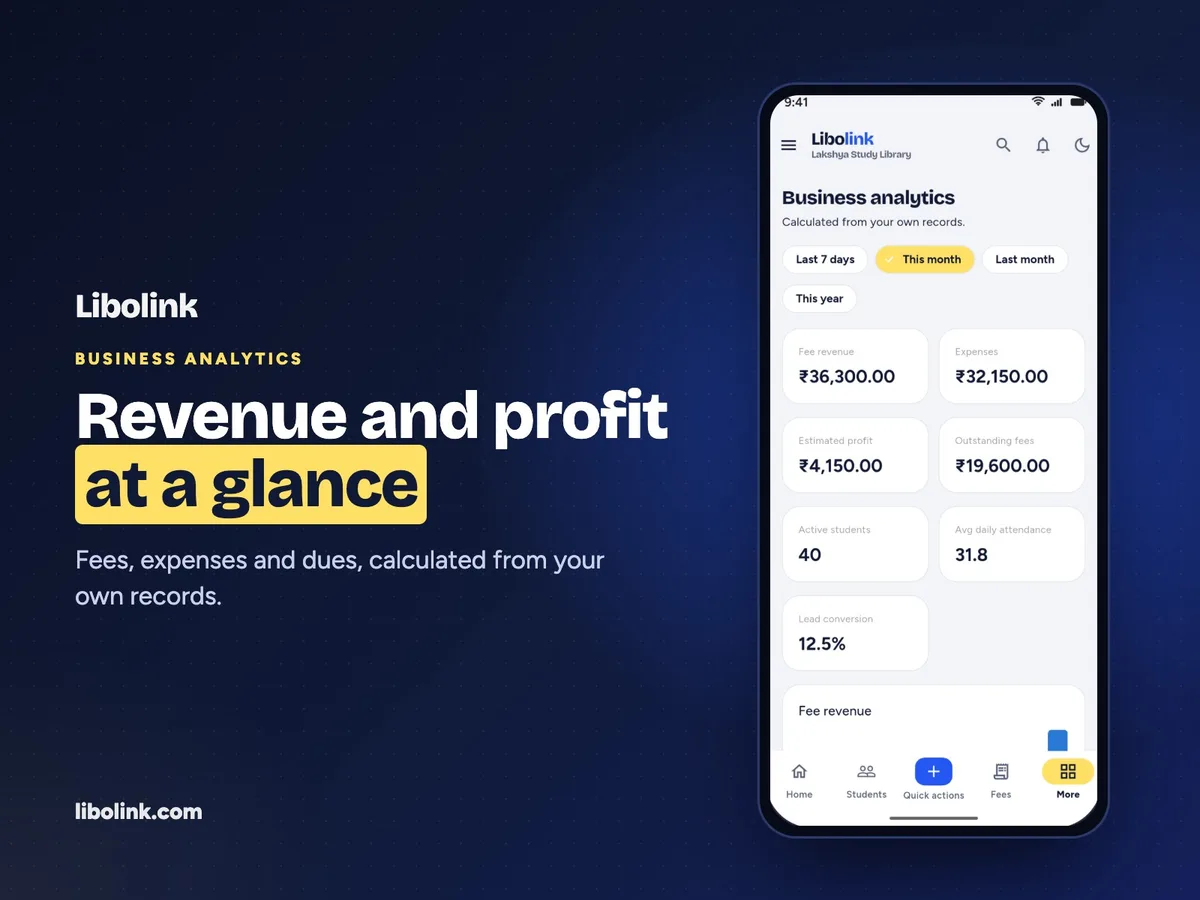
Libolink's business analytics shows fee revenue, expenses and estimated profit for any period, so you can check that the library itself is healthy before investing in an add-on. You can create separate membership plans, for example a premium plan that includes a locker, each with its own price, duration and deposit. Notices tell students about a new service, and students can send suggestions from their app, which is an easy way to find out what they actually want. See the features or start a free trial.
Frequently asked questions
What businesses can I add to a study library?
Common add-ons are a tea and snack corner, vending machines, lockers, printing and stationery, a bookable discussion room, book and notes rental, weekend mock tests and renting a separate room for classes. Choose ones that do not disturb the quiet in the main hall.
Do I need a licence to run a canteen in my library?
Selling food in India needs FSSAI registration. Small food businesses can usually start with basic registration, which covers annual food turnover up to ₹12 lakh. Check local rules as well.
Can a study library have a discussion area?
Yes, as long as it is a separate room where sound does not reach the study hall. Many libraries rent it by the hour for group study and doubt sessions.