

Documents and Licences Needed to Open a Study Library in India
Key takeaways
- There is no single "library licence" for a private self-study library in India. You register it like any other small business that rents space to customers.
- Most owners need a rent agreement that allows commercial use, Shops and Establishments registration, and a trade licence where the city asks for one.
- Fire safety is the paper that gets libraries sealed. Check that the building is approved for this use, and never run a library in a basement or parking area that is not approved for people.
- Udyam registration is free and online, and it helps when you open a current account or apply for a business loan.
- GST is needed only after turnover crosses the limit (₹20 lakh a year for services in most states), so many small libraries do not need it at the start.
A self-study library rents a quiet seat to students for a few hours a day. It does not teach and does not usually lend books, so in most states it is not treated as a school, a coaching centre or a public library. Legally it is a small commercial establishment, and the papers are the ones any shop or office in your city needs.
Rules differ by state and by city, and they change. Use this list to prepare, then confirm the exact requirements with your municipal office, the state labour department portal or a CA before you open.
The short answer
| Document | Why you need it | Where you get it | Needed? |
|---|---|---|---|
| Aadhaar, PAN, photo | Identity for every other registration | You already have them | Always |
| Rent agreement or ownership papers | Proves you can use the premises | Landlord, notary or sub-registrar | Always |
| Shops and Establishments registration | Registers your premises as a business | State labour department, usually online | In most states |
| Trade licence | Permission to run a business in the city | Municipal corporation or nagar palika | Where your city requires it |
| Fire safety (extinguishers, fire NOC) | Safety of students and staff | Fire department | Extinguishers always; NOC where rules require it |
| Udyam registration | Recognises you as a micro enterprise | Free online portal | Optional, but useful |
| Current account and UPI QR | Fee collection in the library's name | Any bank | Strongly advised |
| Commercial electricity connection | Correct tariff for a business | Your electricity company | Usually |
| GST registration | Tax on your fees | GST portal | Only above the turnover limit |
1. Premises papers come first
Before you buy a single desk, make sure the space can legally be used as a library.
- Rent agreement. Get it in writing, mention that the premises will be used as a study library, and agree on who pays for repairs, electricity and any licence fees. Many owners sign 11-month agreements; longer leases usually need to be registered, so ask the landlord or a lawyer.
- Owner's permission. If the building is in a housing society or a residential area, check that commercial use is allowed. Some cities allow small businesses in mixed-use areas and not in purely residential ones.
- Sanctioned use of the building. This is the check most owners skip. A basement or stilt parking that is approved for storage or parking is not approved for 50 students sitting in it for eight hours. After the July 2024 basement flooding in Delhi, authorities in several cities inspected and sealed study centres and libraries running in basements. Ask the landlord for the approved building plan, or ask the municipal office, before you sign.
2. Shops and Establishments registration
Every state has a Shops and Establishments Act. It covers most commercial premises, including offices and service businesses, so a study library usually falls under it. You apply on your state labour department's portal with your ID, the premises address and proof, the business name and the number of workers.
Some states ask for full registration, while others only want a simple online intimation for small establishments with few workers. Many states also expect you to register within a few weeks of opening. The certificate is also one of the business proofs a bank accepts for a current account.
3. Trade licence and local permissions
Many municipal corporations and nagar palikas issue a trade licence (sometimes called a health or business licence) for businesses inside city limits. Whether a study library needs one depends on your city, so ask at the municipal office or check its website.
Also ask about:
- Signboard permission. Some cities charge a fee or need permission for a board facing the road.
- Property tax category. A commercial use can change the property tax rate, which your landlord may want to discuss.
4. Fire safety
This is the most important item on the list. A library packs many people into one hall, often with AC, inverters and dozens of charging points.
- Keep fire extinguishers of the right type (ABC extinguishers are common for mixed risks) near the entrance and in the hall, and get them refilled on time.
- Keep a clear exit path. Do not lock the main gate while students are inside, and do not block the stairs with cycles or furniture.
- Use proper wiring and MCBs for AC and charging points, not long extension boards.
- Put up emergency lights and an exit sign.
A fire NOC is needed where your state's rules or the building's size, height or use require it. Some cities ask for it before they issue a trade licence. Ask the local fire station what applies to your building, and keep the NOC and refill records where an inspector can see them.
5. Udyam, bank account and UPI
- Udyam registration is free and online on the government's Udyam portal (udyamregistration.gov.in), using your Aadhaar and PAN. It gives you a certificate as a micro enterprise. Banks often accept it as business proof, and it helps if you later apply for a Mudra or other small-business loan.
- Current account. Open one in the library's name so that fee money stays separate from your personal account. The bank will usually ask for Udyam, the Shops Act certificate or GST as business proof.
- UPI QR in the library's name. Students trust a QR that shows the library's name more than one that shows a person, and your fee records stay clean. See How to Collect Library Fees by UPI and Cash.
6. Electricity connection
A library uses lights, fans, AC and charging for many hours every day. Running it on a domestic connection can mean a penalty from the electricity company if it is checked. Ask your electricity company to change the connection to the commercial (non-domestic) category, and plan the sanctioned load for your ACs before you install them. The bill will be higher, so include it in your costs.
7. GST and income tax
- GST registration is required once your annual turnover crosses the limit: ₹20 lakh for services in most states, and ₹10 lakh in a few special category states. A 50-seat library that collects ₹80,000 a month earns ₹9.6 lakh a year, so many small libraries are below the limit when they start. You can also register voluntarily. Ask a CA which rate and category apply to your fees.
- Income tax. Your library income is business income. Keep every receipt and expense so your CA can file your return, and so you can show income when you apply for a loan.
8. Things you usually do not need
- A library science degree or librarian certificate. These are for book-lending libraries, not study libraries.
- NGO, trust or society registration. That is for free public libraries that want grants or donations, not for a paid study library.
- Education department registration. A self-study library that only rents seats is not a school. If you add classes, coaching or mentoring, check your state's coaching-centre rules, because some states have their own registration law for coaching.
- FSSAI. You need it only if you sell food or tea. A small canteen usually needs the basic FSSAI registration.
Order to do it in
- Check the building's approved use and sign the rent agreement.
- Apply for Udyam the same day (it is free and takes minutes).
- Apply for Shops and Establishments registration.
- Open the current account and get a UPI QR in the library's name.
- Ask the municipal office about the trade licence, and the fire station about the NOC, while the interiors are being done.
- Change the electricity connection to commercial before the ACs go in.
- Register for GST when you are close to the limit, or earlier if your CA advises it.
Keep your own records ready too
Inspectors, banks and landlords also ask what is happening inside: how many students you have, and whether fees are recorded. Keep an admission form for every student, with a guardian's number for anyone under 18, and keep fee receipts and expenses in one place. Library Register Formats lists the columns to keep, and How to Start a Self-Study Library covers every other step of opening.
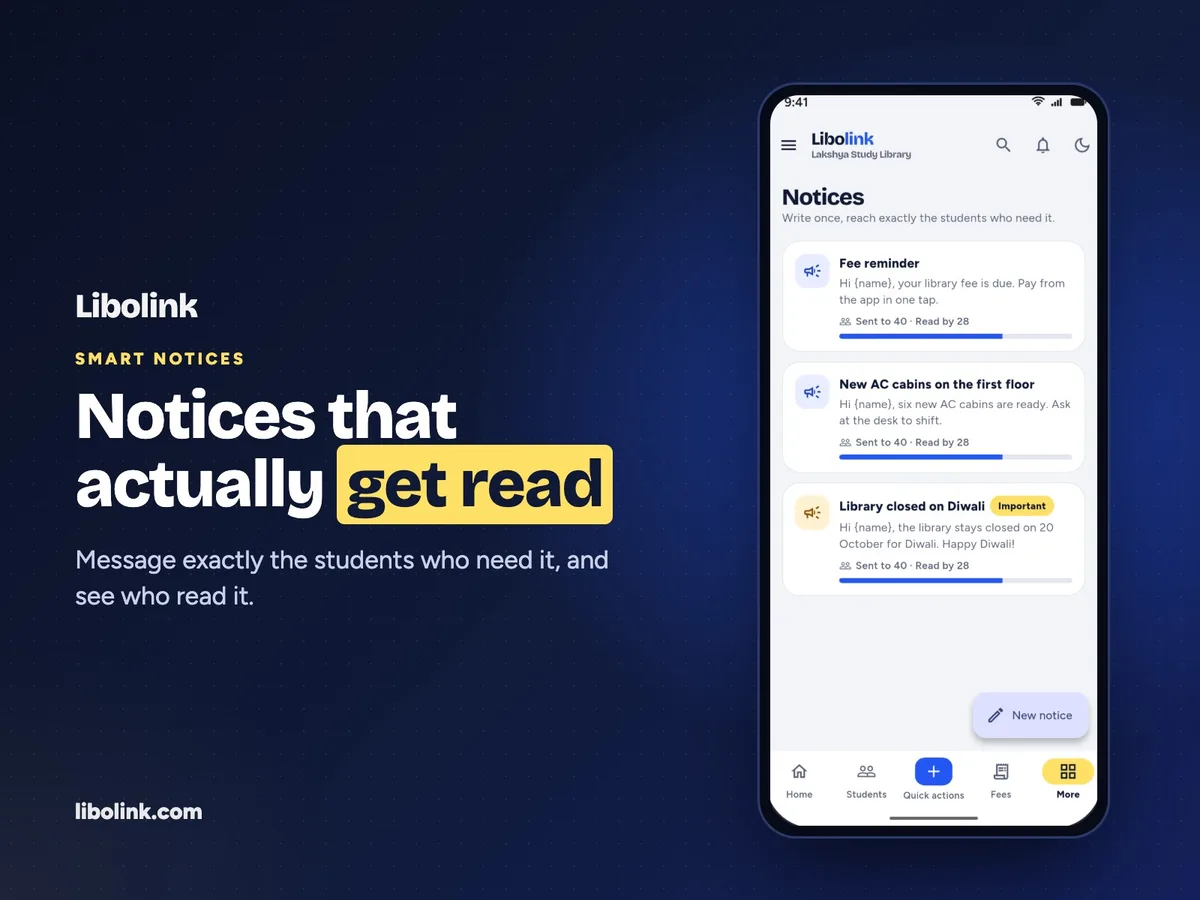
Libolink keeps each student's details, payments with numbered receipts, seats and notices in one place on your phone and computer, so your records are ready when a bank, CA or inspector asks. Start a free 14-day trial or see how it works.
Frequently asked questions
Do I need a licence to open a self-study library in India?
There is no single library licence for a private study library. Most owners register under their state's Shops and Establishments Act, take a trade licence where the city requires one, and follow fire safety rules. Confirm the exact list with your municipal office or a CA.
How do I register a self-study library?
Get your rent agreement, then register under your state's Shops and Establishments Act on the labour department portal, take Udyam registration online for free, open a current account in the library's name and ask the municipal office about a trade licence.
Is GST registration needed for a study library?
Only when annual turnover crosses the limit, which is ₹20 lakh for services in most states and ₹10 lakh in a few. Many small libraries start below it. You can also register voluntarily; ask a CA about the rate.
Can I open a study library in a basement?
Only if the building plan approves the basement for people to sit and work there, and the fire rules are met. Basements approved for parking or storage are not safe or legal for a library, and several cities have sealed basement libraries.
Can I open a library at home or in a residential area?
It depends on your city's rules and your housing society. Some areas allow small businesses in mixed-use buildings and some do not. Ask the municipal office and your society before you spend on interiors.