

How to Start a Self-Study Library in India: Step-by-Step Guide
Key takeaways
- Check demand first: visit nearby libraries and coaching areas, and note their seats, shifts and fees.
- Location decides most of your success: close to coaching centres, hostels and PGs, quiet, safe and easy to reach.
- Plan seats and shifts before you buy furniture. Many owners plan about 20–25 sq ft per seat including aisles.
- Sort out registrations early: Shops and Establishments, a trade licence where your city needs one, and GST once turnover crosses the limit.
- Set up fee, seat and attendance records before the first student joins.
A self-study library (also called a reading room or study centre) rents a quiet, comfortable seat to students for a fixed time each day. Most members are preparing for competitive exams such as UPSC, SSC, banking, NEET or JEE, or for university exams, and want a place with fewer distractions than home. The library earns monthly membership fees. It does not usually lend books.
This guide walks through the steps in the order most owners take them.
1. Check demand in your area
Before you sign a rent agreement, spend a few days studying the area.
- Visit the libraries nearby. Note how many seats they have, which shifts they run, what they charge, and whether seats are full in the morning and evening.
- Walk around coaching centres, hostels, PGs and colleges. Students who live in shared rooms are the core audience.
- Ask a few students what they pay now and what they dislike about their current library: noise, heat, crowding, broken Wi-Fi or poor washrooms.
- Check when exam seasons peak. Demand often rises in the months before major exams, so your opening date matters.
If existing libraries are full and have waiting lists, that is a strong signal. If they are half empty, you will need a clear reason for students to switch, such as better seating, AC, longer hours or a safer location.
2. Choose the location and space
Students choose a library they can reach quickly and feel safe in, including late in the evening.
- Close to students: within walking or short cycling distance of coaching centres, hostels and PGs.
- Quiet: away from loud markets, main-road traffic and wedding halls.
- Safe: a well-lit entrance and street, and a building where women students feel comfortable after dark.
- Practical: working washrooms, drinking water, good ventilation and space for two-wheeler parking.
- Allowed: confirm in writing that the landlord allows commercial use, and check whether your city restricts businesses in residential buildings.
Ground and first floors are easier for students and for power backup wiring. A long rectangular hall is usually easier to fill with seats than an irregular space.
3. Plan seats, layout and shifts
Draw the layout before you buy furniture. A common approach is rows of desks with side partitions (cabins), separated by aisles wide enough for two people to pass.
- Many owners plan roughly 20–25 sq ft per seat including aisles. Measure your own hall and draw it to scale, because pillars, doors and windows change the count.
- Number seats by zone, for example A1–A30 in the AC hall and B1–B20 in a non-AC room, so seat changes and fee plans stay clear.
- Decide your shifts. Common patterns are two shifts (morning and evening) plus a full-day option, or three shorter shifts. Full-day members hold one seat across every shift.
Your capacity is seats × shifts. A 50-seat library with two shifts can sell up to 100 seat-shifts a month, and each full-day member uses two. Self-Study Library Costs and Profit shows how capacity turns into earnings.
4. Registrations and paperwork
Rules differ by state and city, so confirm the exact list with your municipal office or a CA. Owners commonly need:
- Shops and Establishments registration under your state's act, which covers most commercial premises.
- Trade licence from the municipal corporation, where your city requires one.
- GST registration once annual turnover crosses the threshold (₹20 lakh for services in most states, ₹10 lakh in some). Ask your CA which rate applies.
- Udyam registration (free and online) if you want to be recognised as a micro enterprise.
- Fire safety: fire extinguishers at a minimum, and a fire NOC if your building's size or your state's rules require one.
- A written rent agreement that allows commercial use, and a current account for fee collection.
5. Furniture and facilities
Students compare libraries on comfort. Spend on the things they use for hours every day.
- Desks with partitions, and chairs that stay comfortable for six to eight hours.
- A desk light or good overhead lighting at every seat, plus a charging point.
- AC, or enough fans and ventilation for summer.
- Power backup (inverter or generator) so lights, fans and Wi-Fi stay on during power cuts.
- Reliable Wi-Fi with a password you can change.
- RO drinking water, clean washrooms, and lockers if students leave books overnight.
- CCTV at the entrance and in the hall, with a notice that cameras are in use.
6. Set prices and plans
Start from what nearby libraries charge, then adjust for what you offer: AC, cabins, longer hours or a better location. Typical structures are:
- A monthly fee per shift, with a higher full-day fee.
- Discounts for 3, 6 or 12 months paid in advance.
- Separate prices for AC and non-AC zones.
- A refundable security deposit, with the refund rules written down.
Decide early whether fees run by calendar month or from each student's joining date, and put it in your rules. How to Collect Library Fees by UPI and Cash covers both options.
7. Write the library rules
Clear rules prevent most arguments. Print them at the entrance and share them when a student joins.
- Silence in the study hall, and phone calls only outside.
- No food at desks, and where students can eat instead.
- Shift timings, and what happens if a student stays past their shift.
- Seat rules: assigned seats, changing seats and leaving belongings.
- Fees: due date, grace period, any late fee, and the refund policy.
- Guests, smoking, and behaviour that leads to a membership being cancelled.
Study Library Rules for Students has a sample rule board to start from.
8. Set up your records before opening
From the first admission you will track students, fees, seats and attendance. Paper registers work for a small library, but they get hard to search once you have dozens of students across shifts. Whatever you use, set it up before you open so every student is in it from day one. Library Register Formats lists the columns to keep.
9. Launch and fill your first seats
- Create your Google Business Profile with photos, hours and the exact location pin before opening day.
- Put up posters near coaching centres and hostels, and offer a free trial day so students can feel the space.
- Offer an opening discount for the first month, or a referral discount when a member brings a friend.
- Write down every enquiry with a phone number, and call back within a day.
How to Get More Students for Your Study Library goes deeper on marketing.
How Libolink helps
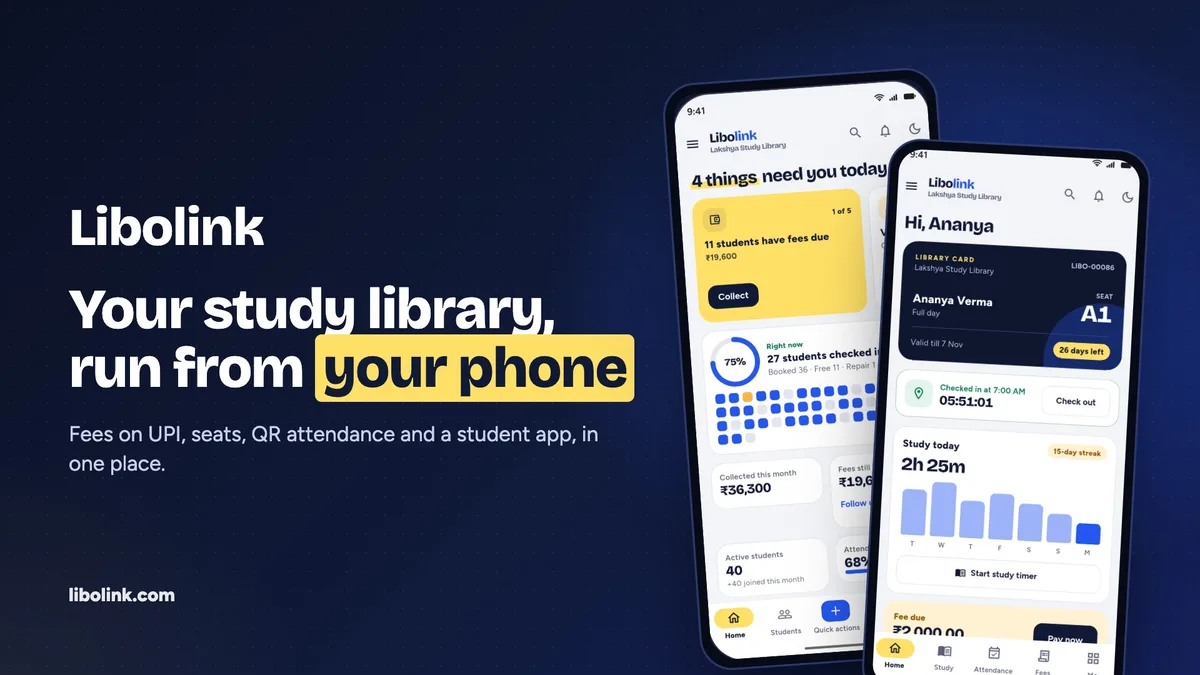
Libolink is library management software built for self-study libraries. During setup you add your shifts, membership plans and seat map, then your students, by hand or from an Excel sheet. After that, fees, seat assignments, attendance and enquiries run from one app on the web, Android and iPhone, in Hindi and English. You can also publish your library's own web page with photos, plans and an enquiry form. Start a free trial or take the product tour.
Frequently asked questions
How much space do I need for a self-study library?
It depends on how many seats you want. Many owners plan roughly 20–25 sq ft per seat including aisles, so a 50-seat library needs around 1,000–1,250 sq ft. Draw your own hall to scale, because pillars, doors and washrooms reduce the usable space.
Do I need a licence to open a study library in India?
Usually you need Shops and Establishments registration under your state's act, and a trade licence where your city requires one. GST registration is needed once turnover crosses the threshold. Rules vary by state, so confirm with your municipal office or a CA.
How long does it take to open a self-study library?
Once you have the space, interiors and furniture typically take a few weeks, and registrations can run alongside. Aim to open a month or two before a major exam season, when students are actively looking for a seat.
Which shifts should a study library run?
Most libraries run either two shifts (morning and evening) with a full-day option, or three shorter shifts. Look at what nearby libraries and coaching timetables suggest and start simple. You can add a shift later.