

7 Numbers Every Library Owner Should Check Each Month
Key takeaways
- A busy-looking library can still lose money. Seven numbers, checked monthly, show what is really going on.
- Check occupancy by shift, not just overall. An empty shift is usually your cheapest growth.
- Look at fees collected and fees still due together. High income with rising dues is a warning.
- Compare students joining with students renewing. If renewals fall, fix that before spending on marketing.
- Twenty minutes on the first of each month is enough, as long as you act on one number.
Ask an owner how their library is doing and you often hear, "It feels full." Feelings are a poor guide. A full morning can hide an empty afternoon, and good collections can hide growing dues.
These seven numbers take about twenty minutes to check. All the example figures below are illustrations, so use your own.
1. Seat occupancy by shift
What it is: filled seats ÷ total seats, for each shift.
Why it matters: your rent is the same whether a seat is full or empty.
What to do: if the morning is at 90% and the afternoon at 40%, do not look for more morning students. Try a lower price or a poster for the afternoon near coaching centres whose timings fit. See Fill Empty Seats.
2. Fees collected
What it is: fee money actually received this month, after refunds, without deposits.
Why it matters: this is real income, not what you expected to get.
What to do: compare it with last month, and with the same month last year if you can. Exam seasons make libraries seasonal.
3. Fees still due
What it is: the total students owe you today.
Why it matters: this is money you have earned but not received, and old dues get harder to collect.
What to do: look at who has owed the longest and call them first. If this number grows every month, your reminders or your follow-up need attention. See 7-3-1 Fee Reminders.
4. Renewals
What it is: of the plans that ended this month, how many renewed?
Why it matters: keeping a student is much cheaper than finding one. Low renewals mean something inside the library needs fixing.
What to do: call a few who did not renew and ask why, kindly. Why Students Leave a Study Library lists the usual reasons.
5. New students and students leaving
What it is: how many joined and how many left this month.
Why it matters: ten new students do not help if twelve left.
What to do: if leaving is close to joining, look at number 4 before you spend on marketing.
6. Enquiries and how many joined
What it is: enquiries this month, and how many became students.
Why it matters: few enquiries is a marketing problem. Many enquiries and few joiners is a follow-up, price or facilities problem.
What to do: call every enquiry within a day. See How to Get More Students.
7. Estimated profit
What it is: fee income minus all expenses: rent, electricity, salaries, repairs and so on.
Why it matters: this is the only number that pays you. It only works if every expense is written down.
What to do: compare it with your break-even from Self-Study Library Costs and Profit. Watch summer electricity if you run AC.
A simple monthly table
Keep this in a notebook if you are not using software.
| Number | Last month | This month |
|---|---|---|
| Morning shift occupancy | 88% | 92% |
| Evening shift occupancy | 55% | 52% |
| Fees collected | ₹62,000 | ₹64,500 |
| Fees still due | ₹9,000 | ₹14,000 |
| Plans ended, and renewed | 20, 16 | 22, 14 |
| Joined, and left | 8, 5 | 6, 9 |
| Enquiries, and joined | 18, 6 | 15, 4 |
| Expenses | ₹54,000 | ₹56,000 |
| Estimated profit | ₹8,000 | ₹8,500 |
In this example, profit looks fine and went up. But dues rose by ₹5,000, renewals fell and more students left than joined. Next month's problem is already visible, and it is not one that profit would have shown you.
Your twenty-minute routine
On the first of each month:
- Write down the seven numbers.
- Circle the one that got worse the most.
- Choose one action for it, and put a date on it.
- Next month, check whether it worked.
One action a month beats a long list you never start.
Where to find them in Libolink
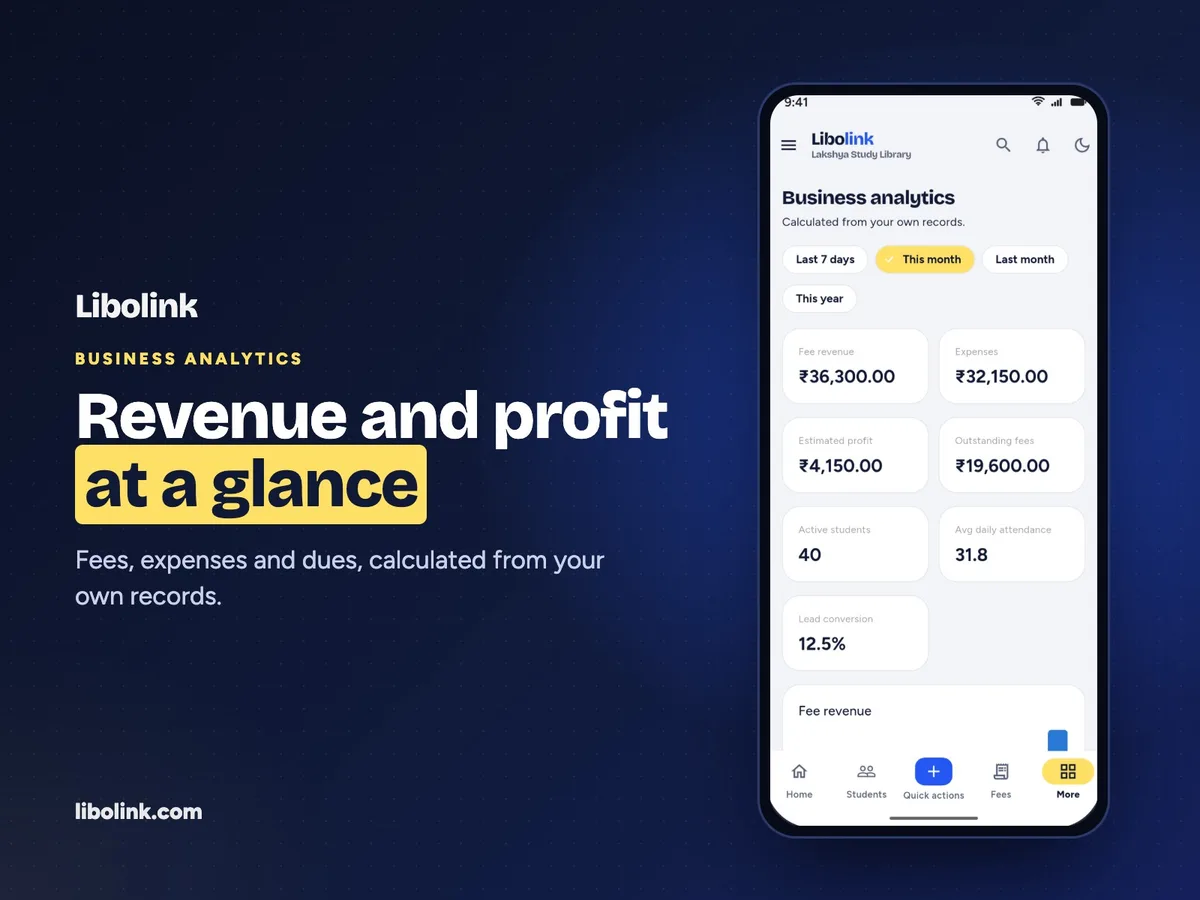
| Number | Where in Libolink |
|---|---|
| Occupancy | Business analytics: Seat occupancy today, Shift occupancy today |
| Fees collected | Home: Collected this month. Business analytics: Fee revenue |
| Fees still due | Home: Fees still to collect. Business analytics: Outstanding fees |
| Renewals | Business analytics: Memberships and renewals |
| New students | Business analytics: Student growth |
| Enquiries | Business analytics: Lead conversion, Leads by stage |
| Profit | Business analytics: Estimated profit, Revenue and expenses |
You choose the date range, so comparing months is quick, and reports can be exported. Business analytics also shows Deposits held, average daily attendance and revenue per active student. Because the figures come from your daily records, there is nothing extra to fill in, apart from adding your expenses.
To see these with your own library, start a free 30-day trial. No card is needed.
Frequently asked questions
What numbers should a library owner track?
Seat occupancy by shift, fees collected, fees still due, renewals, students joining and leaving, enquiries and how many joined, and estimated profit.
What is a good occupancy rate for a study library?
It depends on your costs. Work out your break-even: monthly running costs divided by your average fee per seat-shift. You want to be comfortably above that, and to know which shift is pulling it down.
How often should I check my library numbers?
Monthly is enough for these seven. Fees due and payments to verify are worth a daily look, which is why they are on the Libolink home screen.
Does Libolink calculate profit automatically?
Business analytics shows fee revenue after refunds, expenses and estimated profit for any date range. You add your expenses, and the fee figures come from your payments.