

Library Offers and Discounts That Do Not Lose You Money
Key takeaways
- An offer should fill seats that would otherwise be empty, not give a lower price to students who would have paid in full.
- Do the maths before you announce it: how many extra students does the lower price need to break even?
- Offer on your weakest shift or on longer plans, rather than cutting the price of everything.
- Every offer needs a last date. Without one, the offer price slowly becomes your real price.
- In Libolink, an offer has a name, a price and a last day. Your normal price never changes, and the offer ends by itself.
A good offer fills an empty seat. A bad one gives away money you would have earned anyway. The difference comes down to a little maths and a clear end date.
Do the maths first
An empty seat earns nothing, and your rent is already paid. That is why a lower price on an empty seat can be good business. But the same lower price given to students who were happy to pay in full is simply lost income.
Say your morning shift has 50 seats at ₹800 a month, and 35 are filled. You are thinking of a ₹700 offer.
| Without offer | Offer for new students only | Offer for everyone | |
|---|---|---|---|
| Students paying ₹800 | 35 | 35 | 0 |
| Students paying ₹700 | 0 | 10 new | 45 |
| Income a month | ₹28,000 | ₹35,000 | ₹31,500 |
The numbers are only an example, but the lesson holds: the same offer earns ₹7,000 more when it is for new students, and only ₹3,500 more when everyone gets it. And if only 4 new students come when everyone gets the offer, you earn ₹27,300, which is less than before.
Use your own break-even number from Self-Study Library Costs and Profit.
Offers that usually make sense
- Your weakest shift. Afternoon seats are often empty. A lower price there does not touch your full morning shift.
- Longer plans. A discount for paying 3 or 6 months up front gives you cash now and keeps the student longer.
- First month for new students. It helps someone switch from another library. Say clearly what the price will be afterwards.
- Before exam season. Students are actively looking, and a short deadline helps them decide.
- Festivals. A short Diwali or new-year offer gives you a reason to talk to students and enquiries.
- Referrals. A discount for both the member and the friend they bring costs you nothing unless a new student joins.
Offers to avoid
- No end date. Students wait for the next one, and the "offer" becomes the price.
- A price below your costs on a popular shift.
- Different prices for the same seat with no clear reason. Students talk to each other.
- Fine print. If a student feels tricked at renewal, you lose them and their friends.
How to run an offer in six steps
- Check your empty seats by shift.
- Choose the plan and the price, and do the maths above.
- Set a last date, usually 7 to 15 days away.
- Tell people: students, past enquiries, your WhatsApp status and your Google profile.
- Follow up with everyone who asks, before the date passes.
- When it ends, count the new students. Was it worth it?
Offers in Libolink
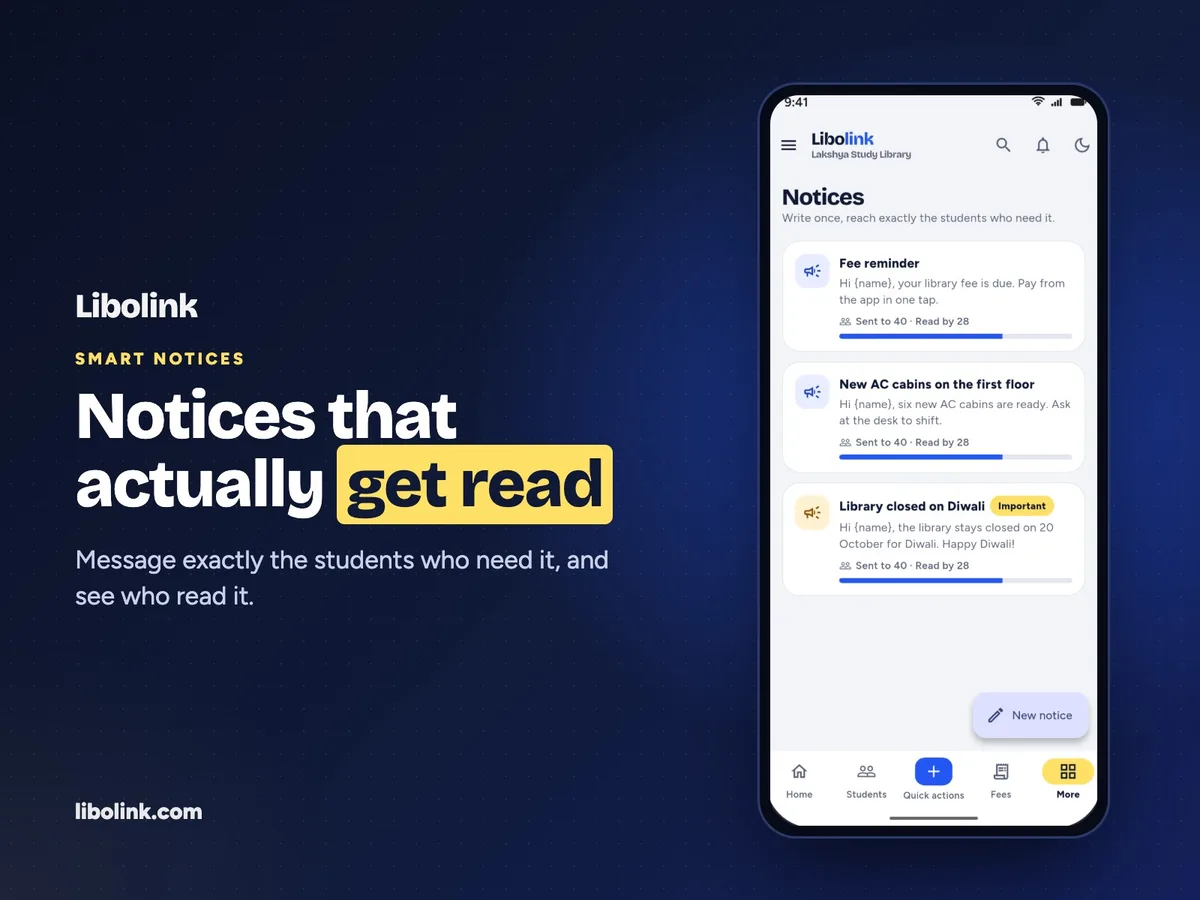
Open Membership plans and tap Offer on a plan. Enter an optional name such as "Diwali offer", the offer price and the last day.
- Your normal price does not change. When the last day passes, the plan goes back to its normal price by itself, and you have nothing to remember.
- Everyone sees the same thing. The offer shows on your plan list, your public library page and your online booking page.
- Add student applies it for you. When a student joins from today, the offer comes up as a discount, so staff do not have to improvise. It does not apply to students with a past joining date, so old fees stay correct.
- Online bookings keep the offer. A student who books during the offer keeps that price when you approve it.
- Renewals in the app get it once. If a student renews from their app during an offer, the saving applies to the first term only, so you do not give it away on a long plan.
- Share it in a tap. Send the offer on WhatsApp with its price, the normal price, the plan's length and the last date.
An offer belongs to the plan, so current students who renew during it get the first-term saving too. To reward only one new student, leave the plan's price alone and use Add discount when you add them.
To reach more students, read How to Get More Students for Your Study Library and Online Seat Booking. To try an offer on your own plans, start a free 30-day trial. No card is needed.
Frequently asked questions
What offer can I give to get more library students?
Give it where seats are empty: your weakest shift, longer prepaid plans, or a first-month price for new students. Add a clear last date and check the maths before you announce it.
Will a discount lose me money?
Only if it goes to students who would have paid in full, or if too few new students join. Work out how many extra students the lower price needs, and keep the offer away from your full shifts.
How long should a library offer run?
Usually 7 to 15 days. A short deadline helps students decide, and an offer without an end date soon becomes your real price.
Does an offer change my normal plan price in Libolink?
No. The normal price stays as it is. The offer has its own price and last day, and it ends by itself after that day.
Do students get the offer price again at every renewal?
No. If a student renews from their app during an offer, the saving applies to the first term only.